The Alice in Wonderland series is a film series based on Lewis Carroll’s classic novels, Alice’s Adventures in Wonderland and Through the Looking Glass. Directed by Tim Burton, Alice in Wonderland (2010) and its sequel, Through the Looking Glass (2016), together form the fantasy film series. The films are set in Carroll’s fantasy world, but incorporate director Tim Burton’s unique visual style and modern fantasy elements.
1. Visual Style: Tim Burton’s Fantasy Charm
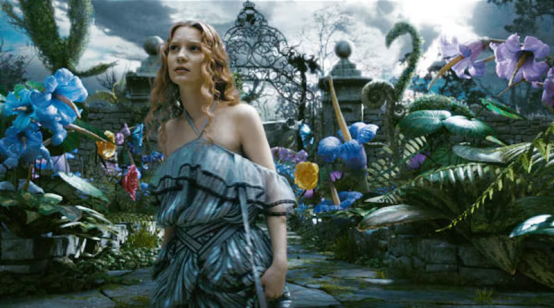
Tim Burton is one of the greatest highlights of the Alice in Wonderland series. As a director, Burton is known for his recognizable “Gothic” aesthetic, a style he seamlessly incorporates into the film’s visual design. The film’s vibrant colors and whimsical shapes present a dream world both absurd and beautiful. Strange animals, distorted landscapes, surreal settings, and inventive character designs are all imbued with Burton’s signature style. The CGI-enhanced “Wonderland” in Alice in Wonderland is particularly breathtaking. From the bizarrely shaped trees to the vibrantly colored forests and a variety of absurd creatures, every frame is visually captivating.
Although “Alice: Through the Looking Glass” still retains Burton’s aesthetic style, the film’s visual exploration is slightly conservative compared to the first one. Although it is still breathtaking, it is slightly lacking in details and novelty.
2. Plot: The confusing interweaving of dreams and reality
While the plot of the Alice in Wonderland series is based on the classic novel, the films have made considerable adaptations to the original story, particularly in terms of character development and plot. The first Alice in Wonderland film wasn’t strictly a remake, but rather set the classic story in a new context, telling the story of a 19-year-old Alice (played by Mia Wasikowska) who re-enters Wonderland and finds herself having to save the world from the tyranny of the Red Queen (played by Helena Bonham Carter).
In the first film, Alice’s adventures are presented in a relatively simple narrative style. From a lost girl, she gradually regains her confidence and strength, and finally becomes the hero who saves Wonderland. The core theme of the story revolves around Alice’s growth from a confused young person to a brave woman, which to some extent reflects the growth and self-discovery in real life.
The second film, “Alice: Through the Looking Glass,” focuses more on exploring Alice’s deeper inner transformation. Through the mirror world, the film further explores Alice’s growth and responsibility, interweaving the story with the mirror world to reveal her conflict and struggle as she navigates the choices between her past and her future. In the film, Alice rediscovers her connection to the world by once again helping the Red Queen and the White Queen reconcile.
However, despite both films’ fantastical undertones, their narratives can sometimes feel overly straightforward, with a fast-paced plot that lacks emotional depth. Alice in the first film is initially overly confused, but ultimately bravely embraces her fate. While the plot is intriguing, some parts lack nuance and depth. The second film, Through the Looking Glass, explores deeper levels of growth and reflection, but the plot drags on, lacking any powerful emotional twists.
3. Character Creation: People and Emotions in Dreams
The character of Alice, particularly as portrayed by Mia Wasikowska, appears both innocent and resilient. Her characterization undergoes a significant transformation in both films, from initial confusion and fear to ultimate determination and courage, a process of growth exemplified through her interactions with Wonderland. While Alice’s inner transformation is more explicit in the films, her performance remains captivating.
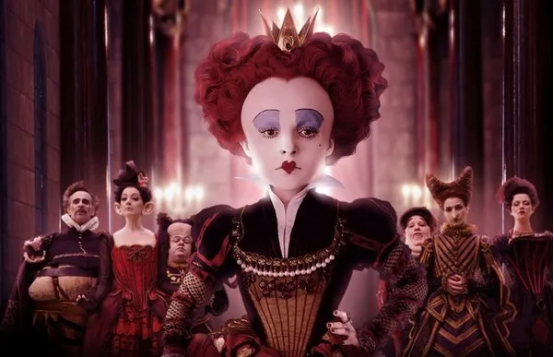
The Red Queen, the villain, has become another iconic figure throughout the film series. Helena Bonham Carter’s unique acting portrays a character both sinister and tragic. Her enormous head and fiery temper have become one of the film’s most memorable visual symbols. While seemingly a typical villain, the Red Queen’s character’s depth is expanded in the second film, Alice: Through the Looking Glass, evoking a complex mix of fear and sympathy.
In contrast, other characters in the film, such as the White Queen (played by Anne Hathaway) and the Mad Hatter (played by Johnny Depp), all possess the Burton-style eccentricity and fantastical charm, but their characters lack depth. The Mad Hatter, in particular, has a very distinct personality, but in some scenes, his presence seems more to add some humor and plot advancement than to truly reveal a complex character.
4. Music: The rhythm of dreams interwoven with emotions
Danny Elfman composed the music for both films, and his score plays a crucial role in both productions. In Alice in Wonderland in particular, Elfman’s music successfully enhances the dreamlike atmosphere, creating a sense of wonder while also maintaining a dreamlike and uncertain mood.
The music in Alice: Through the Looking Glass maintains the same whimsical yet beautiful quality as the first film. The musical variations in the Mad Hatter’s interactions with other characters, in particular, create a wonderful rhythmic effect that enhances the overall fantastical effect. However, the second film’s music can sometimes feel repetitive, lacking the freshness and impact of the first.
5. Overall evaluation: A visual and emotional dream journey
Overall, the Alice in Wonderland series is a visual and emotional feast. Tim Burton’s fantastical visual style successfully interweaves dreams and reality, creating a vibrant wonderland. However, the films fail to reach the expected heights of story depth and emotional depth. While both films boast impressive special effects and acting, their emotional portrayals are superficial, failing to fully capture the profound meaning of the original works.

Related Posts