The Corrupting Influence of Power in Classic Cinema
The pursuit of power has long served as a central thematic pillar in cinematic storytelling, offering a profound lens through which audiences can examine the human condition. When analyzing the narrative structures of classic cinema, particularly through the masterpieces of Citizen Kane and The Godfather, a distinct pattern emerges: the inverse relationship between the acquisition of absolute power and the preservation of personal intimacy. As protagonists ascend to the pinnacles of their respective hierarchies, the psychological and emotional toll manifests as an inescapable, suffocating loneliness. This foundational paradox suggests that the very mechanisms required to gain and maintain control inherently demand the sacrifice of genuine human connection.
Understanding this dynamic requires a multi-dimensional dissection of how power operates within these narratives. It is not merely about wealth or criminal dominance; it is about the illusion of control. The protagonists believe that by manipulating their environments, they can secure their legacies and protect those they care about. However, the tragic irony is that their methods alienate the very people they seek to impress or defend. This progressive isolation is not accidental but a structural necessity of their ambition.
The Psychological Architecture of Ambition
To fully grasp the tragedy of these narratives, we must explore the psychological architecture that drives such relentless ambition. The desire for power often stems from a profound initial deficit or trauma—a loss of innocence or a perceived vulnerability that the protagonist spends their entire life attempting to overcompensate for.
- The Illusion of Security: Characters amass wealth and influence under the mistaken belief that these external resources can insulate them from emotional pain and external threats.
- The Commodification of Relationships: As power grows, every interpersonal interaction is filtered through a transactional lens. Friends, lovers, and family members are reduced to assets, liabilities, or pawns in a larger strategic game.
- The Echo Chamber of Leadership: True power eliminates dissenting voices. The protagonist is eventually surrounded only by sycophants or terrified subordinates, completely severing their connection to objective reality and genuine empathy.
These psychological mechanisms ensure that the protagonist’s ultimate victory is entirely hollow. The empire is built, the enemies are vanquished, but the throne room is empty. This tragic trajectory is meticulously mapped out in both Orson Welles’s and Francis Ford Coppola’s defining works.

Citizen Kane: The Tragedy of Wealth and Absolute Isolation
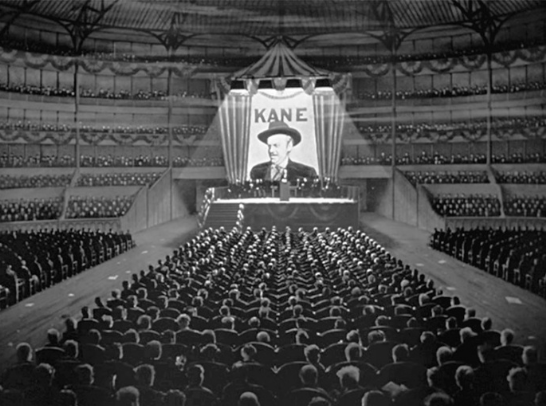
Orson Welles’s 1941 masterpiece, Citizen Kane, remains the definitive cinematic exploration of the American Dream inverted. Charles Foster Kane’s life is a sprawling testament to the idea that infinite resources cannot purchase emotional fulfillment. Kane begins his journey with a massive inheritance, yet his true driving force is a desperate, unquenchable need for love—on his own strictly dictated terms. He attempts to buy the affection of the masses through his newspaper empire and forces his personal relationships to conform to his grandiose vision of himself.
The tragedy of Kane is rooted in his fundamental misunderstanding of love. He views it as a commodity that can be manufactured, packaged, and distributed, much like the sensationalist headlines of the New York Inquirer. When the public and his loved ones fail to reciprocate his highly conditional affection, Kane’s response is not introspection, but a retreat into authoritarian control and eventual total seclusion.
The Symbolism of Rosebud and Lost Innocence
The central mystery of the film revolves around Kane’s dying word: “Rosebud.” While the narrative treats this as a journalistic puzzle, its true significance lies in its representation of Kane’s violently severed childhood. “Rosebud” is the sled he was playing with when he was taken from his mother to be raised by a bank. It symbolizes the last moment in his life when he experienced unconditional, non-transactional love. Every subsequent action in his life—the accumulation of statues, the building of an opera house for his untalented wife, the political campaigns—is a futile attempt to fill the void left by that initial traumatic separation.
Architectural Isolation: Xanadu as a Fortress
The physical manifestation of Kane’s loneliness is his palatial estate, Xanadu. Described as the costliest monument a man has built to himself, Xanadu is less a home and more a mausoleum. It is filled with priceless artifacts from around the world, yet it remains cold, echoing, and profoundly empty. The architecture of Xanadu serves as a direct metaphor for Kane’s internal state.
- Hoarding as Emotional Compensation: The endless crates of unboxed statues and artwork represent Kane’s inability to emotionally process his experiences; he merely collects them.
- Spatial Distancing: Welles famously uses deep focus photography to show the vast physical distance between Kane and his second wife, Susan Alexander, within the cavernous halls of Xanadu, visualizing their emotional estrangement.
- The Prison of Self: The gates of Xanadu, adorned with a “No Trespassing” sign, signify Kane’s ultimate rejection of humanity. He has locked the world out, but in doing so, he has locked himself in.

The Godfather: Family Loyalty vs. Ruthless Ambition
While Citizen Kane explores the isolation of a media magnate, Francis Ford Coppola’s The Godfather (1972) delves into the corrosive nature of power within the framework of the American mafia. The narrative centers on Michael Corleone, a war hero who initially rejects his family’s criminal enterprise. However, a series of existential threats to his father and family force Michael to step into the underworld. What begins as a reluctant duty to protect his bloodline rapidly morphs into a ruthless, all-consuming ambition that destroys the very family he sought to save.
Michael’s descent is a chilling study in moral compromise. He adopts the philosophy that the ends justify the means, believing that his brutal actions are necessary to legitimize the Corleone family and secure their future. Yet, the mechanics of absolute power demand absolute ruthlessness. Michael’s transformation highlights the irreconcilable conflict between the vulnerability required for familial love and the cold calculation required for criminal supremacy.
The Transformation of Michael Corleone
Michael’s arc is marked by a steady shedding of his humanity. In the beginning, he is an outsider to the family business, representing the hope for assimilation and legitimacy. His pivotal decision to assassinate Sollozzo and Captain McCluskey is the crossing of the Rubicon. From that moment, his ascent to the role of Don is characterized by an increasing emotional detachment. He lies to his wife, Kay, orchestrates the murders of rival mob bosses, and eventually orders the execution of his own brother, Fredo. This final act of fratricide is the ultimate proof that the preservation of power has superseded the sanctity of the family.
The Dichotomy of Business and Blood
The tragedy of The Godfather lies in the paradox of its central premise. The mafia operates under the guise of “family,” using the language of loyalty and blood to justify horrific violence. Michael frequently claims, “It’s strictly business, not personal,” yet the collateral damage is entirely personal.
- The Alienation of Kay Adams: Kay represents Michael’s connection to the legitimate, moral world. As Michael’s power grows, he physically and emotionally shuts her out, culminating in the iconic final shot where the door to his office is literally closed in her face.
- The Burden of the Crown: Unlike his father, Vito, who managed to maintain a sense of warmth and community despite his criminal empire, Michael’s rule is characterized by paranoia and cold efficiency. His power isolates him, rendering him a tragic, solitary figure brooding in the shadows of his Lake Tahoe compound.
Comparative Analysis: Charles Foster Kane and Michael Corleone
Placing Charles Foster Kane and Michael Corleone side by side reveals striking parallels in how classic cinema constructs the tragedy of power. Both men start with a specific idealized vision—Kane wants to be the champion of the working class; Michael wants to protect his family and achieve legitimacy. Both men achieve their stated goals of absolute control, yet both end their lives in profound, agonizing isolation.
The following table provides a multidimensional breakdown of their respective journeys, highlighting the thematic intersections of their ascents and subsequent moral declines.
| Thematic Dimension | Charles Foster Kane | Michael Corleone |
|---|---|---|
| Initial Motivation | A desperate need for unconditional love and public adoration. | Duty to protect his father and the survival of his family. |
| Method of Control | Manipulation of public opinion, financial dominance, and media monopoly. | Calculated violence, strategic alliances, and instilling absolute fear. |
| The Turning Point | The political scandal with Susan Alexander that destroys his populist image. | The assassination of Sollozzo, marking his irreversible entry into the mafia. |
| Treatment of Spouses | Treats them as possessions, forcing them into roles to serve his ego. | Excludes them from the truth, treating them as naive outsiders to be managed. |
| Ultimate Fate | Dies alone in a massive, empty palace, longing for his lost childhood. | Sits alone in silent agony, alienated from his children and haunted by his sins. |
This comparative analysis underscores a universal cinematic truth: the architecture of absolute power is inherently incompatible with the architecture of human connection. The fortress that keeps enemies out also traps the ruler inside. Kane’s Xanadu and Michael’s Lake Tahoe estate serve identical narrative functions—they are gilded cages built by men who traded their souls for control.
Cinematic Techniques Highlighting Power and Loneliness
The thematic depth of both films is elevated by groundbreaking cinematic techniques. The directors do not merely tell the audience that these men are isolated; they force the audience to experience that isolation visually and auditorily. The formal elements of filmmaking—cinematography, lighting, and sound design—are meticulously orchestrated to reflect the internal psychological decay of the protagonists.
Deep Focus and Chiaroscuro Lighting
In Citizen Kane, cinematographer Gregg Toland utilized revolutionary deep focus photography. This technique keeps both the extreme foreground and extreme background in sharp focus simultaneously. Welles used this to dictate power dynamics within the frame. Often, Kane is positioned in a way that makes him appear dominant, yet the deep focus reveals the vast, empty spaces surrounding him, emphasizing his isolation. Similarly, Gordon Willis’s cinematography in The Godfather earned him the nickname “The Prince of Darkness.” The heavy use of shadows and underexposed lighting reflects Michael’s descent into moral obscurity. His eyes are frequently hidden in shadow, symbolizing the loss of his soul and his inability to truly connect with anyone looking at him.
Musical Motifs and the Use of Silence
Sound design plays a crucial role in establishing the atmosphere of loneliness. In both films, the grand orchestral scores often give way to oppressive silence during moments of profound realization. In Xanadu, the echoing footsteps and the hollow sound of Kane’s voice emphasize the cavernous emptiness of his life. In The Godfather, Nino Rota’s haunting waltz is frequently contrasted with the dead silence of Michael’s brooding moments, particularly in the film’s closing scenes. The silence becomes a character in itself, a heavy, suffocating presence that surrounds the men who have silenced all opposition.
Frequently Asked Questions (FAQ)
- What is the core thematic similarity between Citizen Kane and The Godfather?
- Both films explore the tragic paradox of power: the relentless pursuit of absolute control inevitably leads to profound moral decay and complete emotional isolation. Both protagonists achieve their ambitious goals but lose their humanity and the people they love in the process.
- How does the concept of “family” differ in both films?
- In Citizen Kane, family is an absence; Kane’s childhood separation drives his lifelong, futile attempt to buy love and manufacture a family unit. In The Godfather, family is initially a sacred institution to be protected, but it is ultimately corrupted and destroyed from within by Michael’s ruthless methods of preserving its power.
- Why is the cinematography of Gordon Willis in The Godfather significant to its themes?
- Willis used heavy shadows and top-down lighting, often obscuring the characters’ eyes. This “chiaroscuro” effect visually represents the moral ambiguity of the mafia world and Michael Corleone’s gradual loss of his soul and transparency as he descends deeper into criminality.
- What does the “Rosebud” sled truly represent in the context of power?
- Rosebud represents the innocence, comfort, and unconditional love Kane experienced before he acquired wealth and power. It signifies that despite his massive empire, the only thing he truly valued was the non-transactional affection he lost as a child, proving that his lifelong pursuit of power was a failed coping mechanism.
- How do both directors use physical spaces to symbolize loneliness?
- Orson Welles uses the massive, echoing, and cluttered halls of Xanadu to show Kane’s emotional hoarding and spatial distance from his wife. Francis Ford Coppola uses the heavily guarded, shadowy, and quiet rooms of the Corleone compounds to illustrate Michael’s paranoia and self-imposed exile from normal human interaction.

Related Posts