The hierarchy within Muzan Kibutsuji’s demonic legions is a brutal testament to power, with the Twelve Kizuki standing as his most fearsome enforcers. At the apex of this organization are the Upper Ranks, demons who have consumed vast quantities of human flesh, survived for centuries, and honed their Blood Demon Arts to unparalleled levels. These individuals are not merely strong; they are strategic masterminds, psychological manipulators, and embodiments of despair, each presenting a unique and often insurmountable challenge to the Demon Slayer Corps. Their very existence represents the culmination of demonic evolution, making their encounters with the Hashira and Tanjiro Kamado’s group some of the most intense and pivotal battles in the series.
Unlike their Lower Rank counterparts, who are frequently replaced, the Upper Ranks have remained largely unchanged for over a century, a chilling testament to their invincibility and Muzan’s unwavering trust in their capabilities. This guide focuses on three distinct Upper Ranks—Gyokko (Upper Five), Hantengu (Upper Four), and Gyutaro (Upper Six)—exploring the intricate details of their origins, the terrifying scope of their abilities, and the profound psychological impacts they have on both their victims and the narrative itself. By dissecting their individual stories and fighting styles, we gain a deeper understanding of the multifaceted evil that the Demon Slayers are sworn to eradicate.
Gyokko: The Avant-Garde of Horror and Deformed Artistry
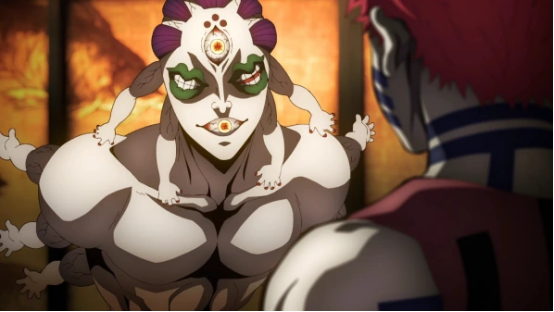
Gyokko, the Upper Rank Five, is a demon whose very being is a contradiction of artistry and grotesque cruelty. His appearance, with multiple arms, a mouth where his eyes should be, and eyes where his mouth should be, reflects his twisted aesthetic. He revels in creating “art” from the disfigured bodies of his victims, finding beauty in the macabre and suffering. This obsession is rooted in his human past, where he was a disturbed child fascinated by death and decay, finding solace in the grotesque after his parents drowned.
Blood Demon Art: Pot Manipulation and Water Control
Gyokko’s Blood Demon Art revolves entirely around his mastery of pots and water, allowing for versatile and unpredictable attacks. He can manifest pots of various sizes, dimensions, and properties, using them as both offensive weapons and means of transportation. His abilities include:
- Pot Teleportation: Gyokko can instantly transport himself or parts of his body between any of his pots, making him incredibly elusive and difficult to pin down. This allows him to ambush opponents from unexpected angles or escape imminent danger with ease.
- Creation of Demonic Fish: He can conjure a multitude of monstrous, water-breathing fish from his pots. These fish possess sharp teeth, incredible speed, and are capable of overwhelming opponents through sheer numbers. A notable technique is the “Ten Thousand Gliding Slime-Fish,” where he unleashes a torrent of highly acidic, venomous fish that can melt human flesh and even corrode Nichirin Swords.
- Water Prison Pot: Gyokko can trap an opponent inside a spherical pot filled with water, preventing them from moving or breathing. This technique is designed to slowly drown his victims, prolonging their suffering and allowing him to admire their despair.
- Transformation into a Fish-like Creature: In his ultimate form, Gyokko sheds his human-like torso to reveal a massive, muscular, fish-like body covered in impenetrable scales. This transformation significantly boosts his physical strength, speed, and durability, making him a formidable close-quarters combatant. He can also generate razor-sharp scales as projectiles.
His combat style combines cunning, psychological torture, and overwhelming offensive power. He enjoys taunting his opponents, criticizing their aesthetic sense, and showcasing his gruesome “artworks” to break their spirits.
Battle Against Muichiro Tokito: Aesthetic Clash and Defeat
Gyokko’s encounter with the Mist Hashira, Muichiro Tokito, during the Swordsmith Village Arc, was a clash of differing philosophies on beauty and utility. Gyokko’s arrogance and obsession with his art ultimately became his downfall. Muichiro, initially incapacitated, unlocked his Demon Slayer Mark, allowing him to perceive Gyokko’s movements and weaknesses more clearly. Despite Gyokko’s powerful transformations and relentless attacks, Muichiro’s renewed focus, enhanced speed, and mastery of Mist Breathing ultimately allowed him to decapitate the Upper Rank Five, exposing his underlying insecurity and lack of true artistic merit.

Hantengu: The Embodiment of Fear and Manifested Emotions
Hantengu, Upper Rank Four, is perhaps one of the most psychologically complex and deceptive demons in Muzan’s ranks. In his primary form, he appears as a frail, elderly, cowardly demon, constantly trembling and claiming innocence. This facade, however, hides a terrifying Blood Demon Art rooted in his deep-seated fear and self-pity from his human life. As a human, Hantengu was a thief and murderer who always blamed others for his actions, believing himself to be the victim despite his heinous crimes. This ingrained denial and cowardice manifested into his demonic abilities.
Blood Demon Art: Emotion Manifestation
Hantengu’s unique ability allows him to split into multiple clones, each embodying a different emotion and possessing a distinct personality and Blood Demon Art. These clones are incredibly powerful and must all be decapitated simultaneously to defeat Hantengu, adding a layer of strategic complexity to his battles. The primary clones are:
- Sekido (Anger): The most aggressive and dominant clone. Sekido wields a long staff that generates powerful electrical attacks, capable of stunning and paralyzing multiple targets. He is the de facto leader of the initial clones.
- Karaku (Pleasure): A carefree and arrogant clone who uses a large fan to generate powerful gusts of wind. These wind blasts can flatten entire landscapes, create barriers, or propel himself at high speeds.
- Urogi (Joy): A winged, bird-like clone capable of flight and sonic screams. His screams are potent enough to cause internal damage and disorientation, making him a dangerous aerial threat.
- Aizetsu (Sorrow): A somber and melancholic clone who wields a spear. His attacks are precise and deadly, often appearing from unexpected angles with incredible speed.
When these four clones are pushed to their limits or destroyed, they can fuse to create an even more formidable entity:
- Zohakuten (Hatred): The ultimate manifestation of Hantengu’s combined emotions. Zohakuten is a youthful, powerful demon with a menacing aura and multiple wooden dragons emerging from his back. He can manipulate wood and sound, creating massive wooden structures that can crush opponents and powerful sonic waves that are devastating at close range. Zohakuten is incredibly resilient and represents Hantengu’s pure, unfiltered hatred and self-righteousness.
Hantengu’s true body, the core of his existence, is tiny and hides within one of his clones or within Zohakuten, making him incredibly hard to locate and defeat.
Battle Against Tanjiro, Nezuko, Genya, and Mitsuri
The battle against Hantengu in the Swordsmith Village Arc was a testament to endurance and teamwork. Tanjiro, Nezuko, and Genya struggled immensely against his multiple forms, constantly having to track and sever multiple heads while searching for his tiny, true body. The arrival of Mitsuri Kanroji, the Love Hashira, provided the much-needed power and speed to contend with Zohakuten. Mitsuri’s flexible and unique Nichirin blade, combined with her immense physical strength, allowed her to hold off the powerful Zohakuten, giving Tanjiro the crucial moments he needed to finally locate and decapitate Hantengu’s true, vulnerable form, despite the demon’s desperate attempts to flee. This battle highlighted the importance of perseverance and the sheer difficulty of facing an Upper Rank demon.

Gyutaro: The Shadow and Bloody Power of the Upper Sixth Moon
Gyutaro, the Upper Rank Six, is a demon whose existence is inextricably linked to his younger sister, Daki. His gaunt, scarred appearance and hunched posture belie immense power and a deeply tragic backstory. Born into the lowest depths of the Yoshiwara Red-Light District, Gyutaro and Daki endured unimaginable poverty, discrimination, and violence. Gyutaro’s childhood was marked by starvation and constant struggle, leading him to develop a profound resentment towards the world and anyone he perceived as privileged or beautiful. His only solace was Daki, whom he fiercely protected. After they were brutally attacked and left for dead, Muzan Kibutsuji found them, offering them demonhood as a twisted form of salvation. This history of suffering fuels his sadistic pleasure in inflicting pain and his obsessive loyalty to Daki.
Blood Demon Art: Blood Manipulation
Gyutaro’s Blood Demon Art centers around the manipulation of his own blood, which he can crystallize into razor-sharp, poisonous sickles. These sickles are incredibly versatile, serving as both melee weapons and long-range projectiles. His abilities include:
- Slicing Blood Sickles: Gyutaro can generate and control multiple sickles from his body, using them in close combat with devastating speed and precision. These sickles are imbued with a potent poison that rapidly weakens and incapacitates his opponents, making their movements sluggish and their breathing labored.
- Flying Blood Sickles: He can launch crescent-shaped blood projectiles that move at incredible speeds and can change direction mid-air. These attacks are difficult to evade and carry the same deadly poison, making them dangerous even at a distance.
- Body Manipulation: Gyutaro possesses remarkable control over his own physiology. He can regenerate rapidly, even from severe injuries, and can retract his sickles back into his body, making him highly resilient in battle.
A unique characteristic of Gyutaro and Daki’s demonhood is their shared consciousness and life force. To defeat them, both siblings must be decapitated simultaneously. This interdependence makes them an incredibly challenging duo to overcome, as one’s strength often compensates for the other’s weaknesses.
Personality: Arrogance, Sadism, and Sibling Bond
Gyutaro is characterized by his extreme arrogance, sadism, and a deep-seated inferiority complex that manifests as resentment towards others’ good fortune. He derives immense pleasure from witnessing the suffering of those he envies. However, beneath this cruel exterior lies an unwavering, almost pathological, love and protectiveness towards Daki. His entire existence as a demon is dedicated to ensuring her survival and upholding their bond, making him a complex villain driven by both malice and a twisted form of familial devotion.
Battle Against Tanjiro, Zenitsu, Inosuke, and Uzui
The fight against Gyutaro and Daki in the Entertainment District Arc was an arduous, high-stakes battle that pushed the Demon Slayers to their absolute limits. Tengen Uzui, the Sound Hashira, along with Tanjiro, Zenitsu, and Inosuke, faced coordinated attacks from both siblings. Gyutaro’s potent poison slowly incapacitated Uzui and Inosuke, forcing Tanjiro and Zenitsu to fight with desperate resolve. The simultaneous decapitation requirement meant that the slayers had to synchronize their attacks perfectly against two incredibly powerful opponents. Despite suffering grievous injuries, the combined efforts of the Demon Slayers, fueled by their unwavering determination, finally managed to sever both Gyutaro and Daki’s heads at the same instant, bringing an end to the Upper Rank Six’s reign of terror and highlighting the immense cost of defeating an Upper Rank demon.

Comparative Analysis: Unique Threats and Shared Traits of the Upper Ranks
While Gyokko, Hantengu, and Gyutaro each present distinct challenges, their shared status as Upper Ranks reveals common threads that make them such formidable adversaries. Understanding these unique threats and shared traits provides critical insight into the nature of Muzan’s most powerful demons.
How Backstories Inform Demonic Nature
- Gyokko: His human fascination with death and disfigurement directly translated into his demonic “art,” where he creates gruesome masterpieces from his victims. His distorted sense of beauty is a direct extension of his pre-demonic psychological state.
- Hantengu: His ingrained cowardice, self-pity, and constant denial as a human manifested into his Blood Demon Art of emotion-based clones. Each clone represents an aspect of his suppressed personality, with Zohakuten embodying his true, deep-seated hatred and self-righteousness.
- Gyutaro: The profound suffering, discrimination, and poverty he experienced with Daki forged his intense resentment and sadism. His Blood Demon Art and his unwavering loyalty to Daki are direct consequences of his desperate human existence and his desire for vengeance against a world that wronged him.
These origins highlight a core theme: Muzan often preys on individuals with deep-seated psychological scars, amplifying their negative emotions and turning them into powerful, destructive forces.
Distinct Combat Styles and Strategic Challenges
Each demon forces the Demon Slayers to adapt entirely different strategies:
- Gyokko: His elusive pot teleportation, ranged water attacks, and sudden transformations demand quick reactions and spatial awareness. Opponents must anticipate his movements and find a way to break through his defenses while enduring his psychological torment. His unique weakness lies in his vulnerability when his true form is exposed.
- Hantengu: The challenge lies in his multiple, powerful clones and the need to locate and simultaneously decapitate his tiny, hidden true body. This requires immense teamwork, endurance, and keen observation, as each clone’s unique ability adds a layer of complexity to the battle.
- Gyutaro: The combined threat of him and Daki, along with his potent poison, necessitates coordinated attacks, precise timing, and exceptional resilience. The simultaneous decapitation rule makes it a race against time as the poison weakens the slayers.
The diversity in their fighting styles ensures that no two Upper Rank battles are ever the same, forcing the Demon Slayer Corps to constantly innovate and push their limits.
The Psychological Depth Behind Their Villainy
Beyond their physical prowess, these Upper Ranks are deeply psychological villains:
- Gyokko: His need for validation for his “art” and his disdain for human beauty reflect a profound insecurity and a desire to impose his twisted worldview.
- Hantengu: His constant self-justification and victim complex make him a chilling portrayal of how denial can breed monstrous cruelty. His clones are not just powers; they are manifestations of his fractured psyche.
- Gyutaro: His hatred stems from a place of deep-seated trauma and injustice. His villainy is a cry of anguish and a desire to make the world feel the pain he and Daki endured, making him a sympathetic yet undeniably evil character.
These psychological layers add significant depth to the narrative, showcasing the complex interplay between human suffering and demonic transformation.

Conclusion: The Legacy of Muzan’s Elite and Their Narrative Impact
The Upper Rank demons—Gyokko, Hantengu, and Gyutaro—stand as monumental antagonists in the Demon Slayer narrative, each contributing significantly to the series’ thematic depth and action-packed intensity. Their individual stories of transformation from deeply flawed or traumatized humans into formidable demons underscore the pervasive influence of Muzan Kibutsuji and the tragic allure of his offer of power.
Their battles are not merely physical confrontations; they are tests of will, strategy, and the unwavering resolve of the Demon Slayer Corps. Gyokko’s grotesque artistry challenged Muichiro Tokito’s perception of beauty and life, pushing the young Hashira to unlock new levels of power. Hantengu’s deceptive nature and multi-faceted emotional clones forced Tanjiro and his allies into a grueling war of attrition, highlighting the importance of teamwork and perseverance. Gyutaro and Daki’s combined might, fueled by a tragic sibling bond and profound resentment, demanded the ultimate sacrifice and synchronized effort from Tengen Uzui and his young companions.
Ultimately, the defeat of these Upper Ranks marks pivotal turning points in the Demon Slayer story. Each victory represents a significant stride towards weakening Muzan’s forces, pushing the protagonists to their limits, fostering their growth, and showcasing the triumph of human spirit over overwhelming demonic power. Their legacies endure not just as terrifying villains, but as complex characters whose tragic origins and formidable abilities cemented their place as unforgettable elements of the Demon Slayer universe.
Frequently Asked Questions (FAQ)
- Q1: What makes the Upper Ranks so powerful compared to other demons?
- The Upper Ranks are distinguished by their immense consumption of human flesh, centuries of survival, and direct infusions of Muzan Kibutsuji’s blood. This grants them accelerated regeneration, highly evolved Blood Demon Arts, and extraordinary physical attributes. Unlike Lower Ranks who are often replaced, Upper Ranks have held their positions for over a century, indicating their unparalleled strength and strategic prowess.
- Q2: How do Gyokko, Hantengu, and Gyutaro’s backstories influence their Blood Demon Arts?
- Their backstories are intrinsically linked to their demonic powers. Gyokko’s human obsession with grotesque objects translated into his pot-based “art” and water manipulation. Hantengu’s profound cowardice and self-pity manifested as his emotion-splitting ability, allowing him to externalize his suppressed feelings as powerful clones. Gyutaro’s life of suffering, resentment, and fierce protectiveness over Daki fueled his poisonous blood manipulation and his sadistic pleasure in inflicting pain, mirroring the suffering he endured.
- Q3: What were the key strategies used by the Demon Slayers to defeat these Upper Ranks?
- Defeating these Upper Ranks required diverse strategies. For Gyokko, Muichiro Tokito had to unlock his Demon Slayer Mark to gain the speed and perception necessary to overcome Gyokko’s evasiveness and penetrate his ultimate form. Against Hantengu, the strategy involved a relentless pursuit of his tiny, hidden true body while simultaneously dealing with his powerful emotional clones, requiring sustained teamwork and endurance. For Gyutaro and Daki, the crucial strategy was the simultaneous decapitation of both siblings, demanding perfect coordination and immense physical fortitude from the Demon Slayers despite debilitating poison.
- Q4: Which Upper Rank is generally considered the most challenging to defeat among these three?
- While all three are incredibly powerful, Gyutaro and Daki (Upper Six) are often cited as presenting one of the most challenging initial Upper Rank encounters due to their combined strength, the potent poison, and the strict simultaneous decapitation requirement. Hantengu’s multiple forms and hidden true body also posed an immense endurance challenge. Gyokko, despite his unique abilities, was defeated by a single Hashira who unlocked his mark, suggesting he might be slightly less complex than the dual threat of Gyutaro/Daki or Hantengu’s evasive forms.
- Q5: What is the significance of the “Upper Rank” title within the Twelve Kizuki?
- The “Upper Rank” title signifies a demon’s unparalleled power, loyalty, and longevity within Muzan’s Twelve Kizuki. These demons are the closest to Muzan in strength and influence, tasked with critical missions and rarely defeated. Their existence is a constant reminder of humanity’s precarious position against demonic forces, and their defeat is a monumental achievement that signifies a significant shift in the balance of power in the Demon Slayer Corps’ favor.

Related Posts